

This month’s briefing Online safety · AI · education
The rules are moving.
Is your school ready?
Online safety policy is becoming product policy. AI use is becoming operational practice. This issue separates the durable signals from the noise—and turns them into five practical moves for school leaders.
The signal
Safety is moving
into the architecture.
The most important shift this month is not a single rule or product. It is the move from asking children to manage risk towards changing the environments in which risk occurs.
Government proposals now reach into age assurance, device controls, stranger contact, livestreaming, addictive design and overnight use. At the same time, schools are moving from occasional AI experiments towards everyday operational use—often without a coherent strategy.
For education leaders, these two movements meet in one place: governance. The task is to preserve opportunity while making safety, privacy and human judgement part of the design.
Ken CorishManaging Director · Orca Advisory
Comes into force 1 September
KCSIE 2026:
read it as a system.
The new edition of Keeping children safe in education should not be treated as a September compliance update. It is a prompt to test whether curriculum, staff development, filtering and monitoring, incident response and leadership oversight operate as one safeguarding system.
Open the statutory guidance ↗Plans to prevent children taking, sharing or viewing nude images
Proposed controls would put stronger safeguards into devices rather than relying solely on awareness and reporting.
UK Government · 8 June 2026 ↗ Under-16 accessThe new rules intended to protect children online
A useful plain-English briefing on social-media access, risky functions, age checks and the proposed implementation path.
UK Government · updated 19 June 2026 ↗Four signals to hold
Children’s online lives
Opportunity and risk
are not opposites.

Children and parents: media use and attitudes 2026
Ofcom’s annual evidence base spans children from six months to 17 and brings parents’ perspectives alongside young people’s use, understanding and attitudes.
Explore the research ↗
Smart tech, safe choices
The Safer Internet Day research offers an education-ready view of how young people experience AI—its creativity and utility, as well as uncertainty and harm.
Read the findings ↗Emerging harm
Two risks that need
a place in policy now.
Neither belongs in a future-horizon document. Both are already part of children’s digital lives.
AI companions are putting children at risk
Regulatory findings identify exposure to sexual content, self-harm risks and weak age assurance. The central question for schools is simple: would a child view this system as a tool—or as a relationship?
Read the regulator’s findings ↗
Deepfake abuse is abuse
Evidence across 11 countries estimates that at least 1.2 million children experienced sexualised image manipulation in a year. Synthetic does not mean victimless.
Open the UNICEF statement ↗AI implementation
The gap is not access.
It is coherence.
strategy
AI in schools: what school leaders need to know
AI is already present in day-to-day teaching and learning, yet formal strategy remains rare. The report’s case studies make a compelling case for moving from individual experimentation to shared purpose, boundaries and professional learning.
Read the report ↗
Efficiency through AI and automation
A controlled 2025–26 pilot shows how a trust can test operational agents before considering wider scale.
Read the case study ↗
AI training across a multi-academy trust
A replicable practitioner account that starts with staff capability and whole-school development—not a product.
Read Alan Stupple’s account ↗How schools and FE colleges are making AI work
Twenty-one settings with at least a year of experience highlight workload, leadership and safeguarding patterns.
Open the DfE synthesis ↗School-centric AI
Education editions
are not strategies.
Two major providers are now packaging general-purpose AI specifically for teachers. Both announcements are significant; both are US-focused. UK leaders still need to test lawful basis, data handling, age suitability, curriculum fit and the quality of professional oversight.
 New release · 14 July 2026
Claude for Teachers
A teacher-focused experience with education skills, integrations and an initial school pilot.
Explore the announcement ↗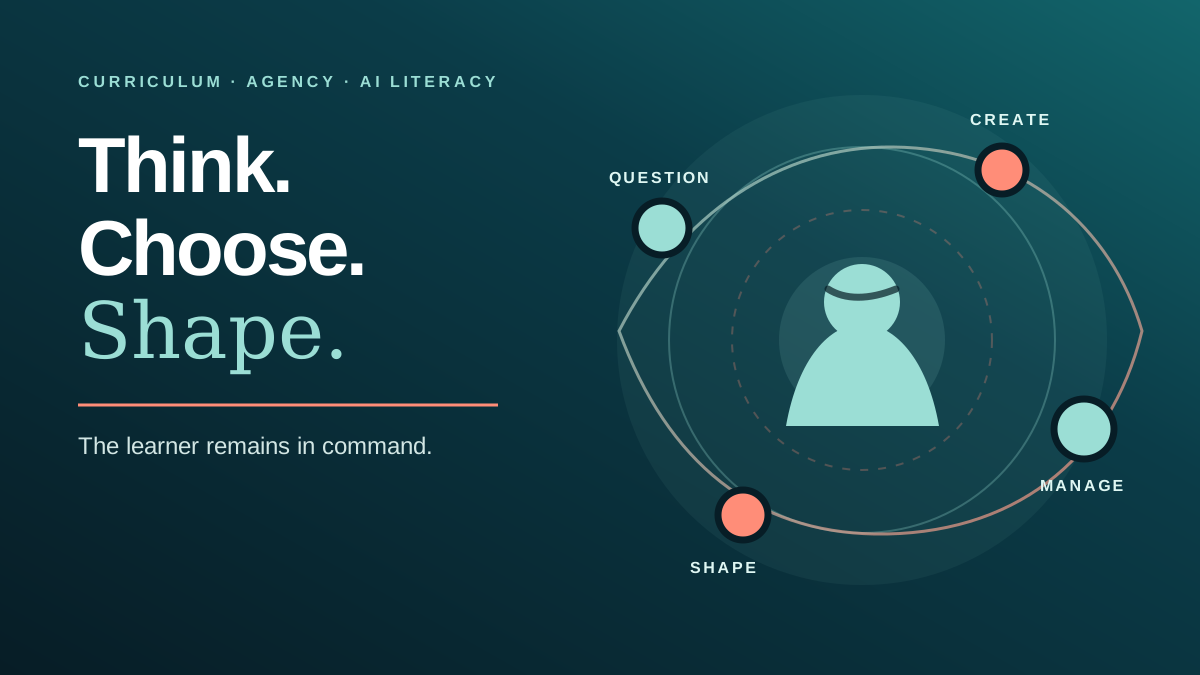 ChatGPT
for TeachersProvider benchmark · 19 November 2025
ChatGPT for Teachers
A protected teacher workspace, free in the US through June 2027, with education training resources.
Review the product details ↗The UK landscape
From content rules
to design rules.
Default social-media curfews and restrictions on addictive features
Proposed midnight-to-6am curfews for 16- and 17-year-olds show policy moving into product mechanics and patterns of use—not just the legality of content.
Read the announcement ↗Online harm as a cross-system challenge
The Youth Justice Board’s evidence pack links prevention, safeguarding, recovery and offending—and makes the case for coordinated education, health, policing, local government and social care.
Open the evidence pack ↗Before the autumn term
Five useful
leadership moves.
Progress does not begin with a new platform. It begins with a shared view of purpose, risk and responsibility.
- 01
Map the change
Brief governors and safeguarding leaders on KCSIE 2026 and the direction of online-safety policy.
- 02
Find your shadow AI
Understand where staff and learners already use AI before writing a strategy or buying another product.
- 03
Extend the threat model
Add AI companions, synthetic intimate imagery and AI-enabled coercion to staff development and response planning.
- 04
Test the learning value
Require a clear pedagogical or operational purpose, evidence of benefit and meaningful human oversight.
- 05
Build student agency
Teach young people to question, choose, create and seek help—not simply to comply with safety instructions.

Need a clearer next move?
Turn the signal into
a workable plan.
Orca Advisory helps schools and children’s professionals connect safeguarding, digital culture and AI strategy—without losing sight of learning or people.